When you picture a synthesizer, your mind probably drifts to fuzzy 8-bit video game soundtracks or those impossibly catchy pop hooks from the 1980s. You might imagine a lush digital orchestra spilling out of a keyboard, or a tangle of cables and knobs on a studio desk. Some of you are picturing a software plugin you tweak with your computer keyboard.
Whatever image pops up, the impact of the synthesizer over the last nearly 50 years runs far deeper than most people realize. These machines are woven into the fabric of everything we hear: pop, hip hop, film scores, and rock and roll. But Dr. Tom Rhea, a professor in Electronic Production and Design at Berklee College of Music, points out something more significant. Synthesizers changed how music is played by decoupling form from function. Acoustic instruments are bound by physics. You can’t easily rebuild a guitar or a clarinet to sound like something else entirely. “With electronic instruments — namely the synthesizer — all that is out the window,” Rhea notes.
This freedom means a single device can produce familiar tones and utterly alien ones. It can mimic a flute, create the sound of an ocean swell, or generate a Martian’s ray gun. It can even invent voices that have never existed.
There is a common misconception here. The word “synthesizer” does not mean the sounds are fake or synthetic. It refers to synthesis. This is the process of combining fundamental properties of sound to create a new whole. Another myth to drop is that these are magic boxes. They aren’t voodoo devices that write songs for you. They are instruments that require human input.
So, how does a synthesizer manipulate sound? To understand that, we need to look at the building blocks of audio.
The Physics of a Note
A sound is essentially energy traveling through air pressure changes to your ear. Humans hear frequencies between 20 and 20,000 hertz. We perceive every sound by its pitch, timbre, and loudness.
Even if two instruments play the exact same note, their measurable characteristics differ. Consider these core components:
- Frequency : The number of wave repetitions in one second.
- Amplitude : The volume, or change in air pressure.
- Wavelength : The physical distance between cycles of a waveform.
- Period : The time it takes for a waveform to complete one full cycle.
Sounds also contain harmonics. These are layers of frequencies that blend to create a complex voice. Finally, there is the lifespan of a sound. How it changes from the moment it is struck until it fades. This is known as ADSR : Attack, Decay, Sustain, and Release.
“With electronic instruments — namely the synthesizer — all that is out the window,” says Dr. Tom Rhea.
Subtractive vs. Additive Synthesis
Most people encounter subtractive synthesis first. It is one of the most common methods for generating tones. You start with a raw waveform. This initial sound contains all the characteristics mentioned above. Then, you strip away elements. You silence certain frequencies or emphasize others.
The result is a completely different tone. The output might resemble a trumpet, a snare drum, or an atmospheric whoosh. It can be virtually anything. However, unless you use a sampler to record and process acoustic sounds, a synthesized version will never be an exact copy of a real-world instrument. It is an approximation, not a clone.
On the other side of the spectrum lies additive synthesis. This method works in reverse. Instead of removing parts, you layer tones on top of each other. You build a more complex sound by adding components together.
Under the Hood of a Synthesizer
Knowing how sound is manipulated is only half the story. To truly understand these machines, we need to look at the hardware and software components that make this manipulation possible.
What are the basic components of a synthesizer?
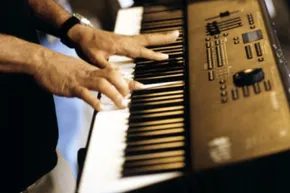
Synthesizers have that familiar piano keyboard. But look closer at the rest of the chassis. It’s a mess of knobs, dials, and switches. It looks like it belongs in a garage, not a concert hall. Yet, the machine holds the same two core components as any acoustic instrument: a generator and a resonator.
Think of a violin. The strings and bow are the generator. The wooden body is the resonator. On a synthesizer, the roles shift. The oscillator is the generator. The filter is the resonator.
Let’s break down the classic analog synthesizer. Digital versions are different beasts. We’ll get to them later. Analog synths generate sound by manipulating electric voltages. It’s pure physics meets engineering.
The Signal Chain: Voltage, Filter, and Amplifier
The oscillator shapes these voltages. It produces a steady pitch at a specific frequency. This defines the basic waveform. The signal then moves down the line.
You control the oscillator. Piano keys work. A pitch wheel rolls. Or you tweak other interface tools. The goal is to set the raw tone.
Next, the signal hits the filter. Here, you use knobs to carve out the sound. You eliminate frequencies. You emphasize others. It’s like sculpting clay. The filter defines the tone color.
From the filter, the signal travels to the amplifier. This part controls volume. But it’s not just a simple on/off switch. The amplifier includes envelope controls. These shape the volume over the note’s lifespan. Attack. Decay. Sustain. Release. The envelope determines how the sound breathes.
Modular Madness
In analog synthesizers, these functions are organized into modules. Each module has a specialized purpose. Pitch. Tone. Loudness.
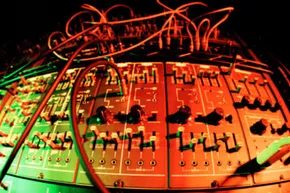
The earliest modules were encased in individual housings. Each unit created or processed a specific signal. Musicians connected them with patch cables. This modular approach allowed for layering and complex processing. You could change the sound into something entirely new. It was a puzzle of electricity.
The History of Synthesis
When was the first synthesizer invented? The answer depends on who you ask.
Some point to the Telharmonium. Invented in the late 1890s. Or the theremin. Created in 1919. These are electronic instruments. But Rhea, a historian of the field, disagrees. These early devices didn’t grant complete control over sound elements. They lacked the fundamental architecture of synthesis.
The first true synthesizer was a hybrid. It combined piano keys with electronic technology. Invented in France in 1929 by Armand Givelet and Eduard Coupleaux. It used a paper tape reader. It manipulated electronic circuits. It could create an orchestra of four voices.
The word “synthesizer” itself entered the lexicon later. The RCA Electronic Music Synthesizer Mark I was released in 1956. It used tuning forks. It read information punched onto paper tape rolls. It played music through loudspeakers.
Robert Moog and the Modern Era
Robert Moog is widely considered the father of the modern synthesizer. He was an American electrical engineer. He built theremins in his spare time. In the early 1960s, he befriended musician Herbert Deutsch. This friendship sparked a collaboration.
Moog set out to invent the first commercially available synthesizer. The result was the 900 Series Modular Systems. Released in 1964, these units towered like mainframe computers. A spiderweb of cables “patched” the modules together. The system could sequence sounds or play in real time. It was complex. It was powerful.
It was also polarizing. Moog’s early marketing failed to convince the music establishment. “As a salesperson, I went into music stores where I was practically thrown out,” Rhea recalls. “I was told that [the synthesizer] wouldn’t be a musical instrument.”
Then came Switched-On Bach. Wendy Carlos’s Grammy-winning album dropped in 1968. It exposed the musical possibilities of synths to a broader audience. Suddenly, the noise-makers were instruments.
Groups like Parliament-Funkadelic, the Mahavishnu Orchestra, and Emerson, Lake, and Palmer adopted the technology. The pivotal moment, however, was the Minimoog. It consolidated the large modular elements into a single, portable unit. It was less expensive. It put 13,000 synthesizers into the hands of performing musicians during its production life.
Musicians still honor Moog today. The annual Moogfest in Asheville, N.C., keeps his legacy alive. Even as digital technology took over, the analog sound remained iconic.
Other Pioneers
Moog wasn’t the only game in town. Don Buchla and Alan R. Pearlman were also pioneers of the modern synthesizer.
Buchla’s 100 Series synthesizers arrived around the same time as Moog’s first units. They used pressure-sensitive touch plates instead of piano keys. This interface appealed to avant-garde musicians and academics. It offered a different kind of control.
Pearlman’s ARP2500 and 2600 arrived in the early 1970s. These resembled scaled-down modular synthesizers. Rock acts used them heavily.
Despite their innovation, neither Buchla nor Pearlman approached the popularity of Moog’s instruments. Moog’s designs became the standard. They defined the era.
Going Digital
The analog era dominated for decades. But technology moved forward. Digital synthesizers began to replace their analog counterparts. Why? The reasons are technical. And economic. And they changed everything about how we make sound.
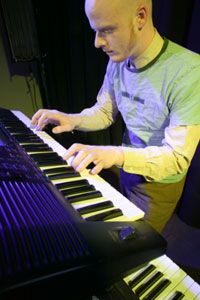
It wasn’t an accident that digital took over. It was economics.
Rhea puts it bluntly. Digital instruments cost less to make. They sell for less. The average musician playing a hotel ballroom in the 80s wasn’t dropping $15,000 on a synth. They couldn’t.
Analog gear is expensive. Digital gear is scalable. That’s the real story here. Not sonic superiority. Pitch stability is better in digital, sure. But the market chose the cheaper option.
The circuit boards tell a different story than the knobs. Analog synths rely on voltage. Digital synths rely on code. Processors and algorithms interpret binary strings. Those strings become sound waves. It’s math making noise.
This wasn’t invented in a vacuum. Research started in 1957. Max Mathews at Bell Labs wrote Music I. The first computer program to play music. It took decades to get from there to commercial hardware.
How Digital Synthesizers Changed Music Production
The first wave hit in the 1980s. The Yamaha DX7 arrived in 1983. It became an early bestseller. It changed everything.
Producers needed sound. Hip-hop. Pop. Rock. Electronic. Digital synths became indispensable. Composers use them for film scores too. Sometimes it’s an aural sketch. Later filled with live instruments. Sometimes it’s the entire soundscape. Rendered completely by code.
Forms branched out. Early add-on devices linked to desktop computers. Then came software programs. They relied on the computer’s hardware to do the heavy lifting.
Then there’s the virtual analog synthesizer. It’s a hybrid concept. The interface looks like analog. Knobs. Dials. A physical keyboard. But underneath? Digital technology drives everything. It mimics the look. It uses digital processing.
The Role of MIDI in Modern Audio Workflows
Digital synths didn’t work in isolation. They needed to talk to other devices.
Enter MIDI. Musical Instrument Digital Interface. Introduced in 1983. The same year as the DX7. It’s a protocol. It links synthesizers to sequencers. Samplers. Drum machines. All sorts of electronic gear.
It connects to digital audio workstations too. Avid’s Pro Tools. Apple’s Logic. MIDI is the glue. It turns a collection of gadgets into a single workflow.
The Democratization of Music Creation
Barriers are gone.
Synthesizers put the ability to make music in anyone’s hands. If you have the inclination, you can create. The tech is accessible. Affordable. Everywhere.
This has a double edge.
There are wonders. New sounds. New styles. Accessibility for true beginners.
But there are horrors too.
“The democratization of music, with the concomitant horrors and wonders.” — Rhea
Your neighbor with a voice like broken glass can record a song. Just as easily as a Juilliard-trained vocalist. The skill gap is narrowing. The barrier to entry is nearly zero.
This is the upshot. More music. Less filter.
For more on audio gadgets, check the links on the next page.