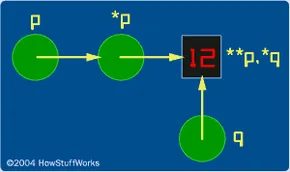
It sounds like a recursion nightmare, but pointers to pointers are a staple of systems programming. You are essentially pointing at a memory address that holds the address of your actual data. This double-layer indirection is what developers call a handle. It isn’t just a coding trick. It is a necessary mechanism for operating systems to manage heap memory efficiently.
Consider the heap as a crowded room. Sometimes the OS needs to shuffle people around to make space. If you hold a direct pointer to someone, they can’t move without breaking your reference. But if you hold a pointer to a list of names, the OS can change the location of any person in that list without you needing to update your initial reference. That is the power of a handle.
Here is how that logic translates into raw C code. You declare p as a pointer to a pointer. Then q becomes a standard pointer. You allocate memory for p, then allocate memory for what p points to. Finally, you dereference twice to assign the value 12.
Windows and macOS rely on this structure for memory compaction. The distinction here is vital. You, the programmer, manage the outer pointer p. The operating system manages the inner pointer *p. Because the OS controls *p, it can relocate the actual data block (**p) anywhere in the heap. It simply updates *p to reflect the new address. Your code keeps using p without a hitch.
Beyond OS memory management, this pattern is essential for passing pointers to functions. If you need a function to modify a pointer itself, you pass a pointer to that pointer. It is the only way to reassign the reference from within a different scope.
Managing Pointers to Structures
The complexity doesn’t stop at simple integers. You can nest this logic inside structures. This is common when handling variable-length data like strings.
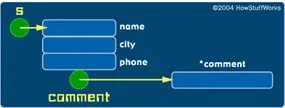
Take the Addr structure. It holds fixed-size arrays for names, cities, and phones. But comments vary in length. So comment is defined as a pointer to char. When you allocate memory for the structure itself, you are reserving space for the pointers and the fixed arrays. You are not reserving space for the actual comment text yet.
You allocate s first. Then you read user input into the fixed buffers. After that, you read the comment into a temporary
You lose memory when you ignore how pointers nest.
Take a pointer s that points to a structure. That structure holds another pointer. That second pointer points to an actual string in memory. Two layers of indirection. One allocation for the struct. One allocation for the string.
Simple enough until you try to clean up.
Here is where most developers trip. You see free(s). You think you are done. You are wrong.
Look at this code snippet:
The variable s points to the Addr structure. Inside that structure, there is a field comment. comment points to a block of heap memory allocated for the string data.
When you call free(s), you release the memory for the structure itself. The Addr struct is gone. The memory is returned to the system.
But what happens to s->comment?
It disappears into the ether.
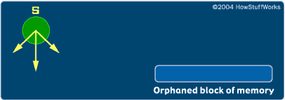
The pointer to the string data was stored inside the structure you just freed. You cannot access it anymore. You did not call free() on the string. The memory remains allocated but unreachable.
This is a memory leak.
It is not a crash. It is not an error message. The program runs fine. It just slowly consumes more RAM until the system swaps or crashes.
How to fix double pointer leaks
You have to free the inner pointer first. Or store it in a temporary variable before freeing the outer structure.
Now the string data is released. Then the structure is released. No lost blocks.
Why this happens so often
People treat pointers as values. They forget that pointers are references to resources.
When a structure contains a pointer, that structure is not self-contained. It relies on external memory. Freeing the container does not free the contents.
This gets worse with deeper nesting. A pointer to a pointer to a pointer. Three levels. You need three free() calls. In the right order.
If you forget one, you leak.
The gets() problem
The example uses gets(). That function is dangerous. It has been removed from the C11 standard because it allows buffer overflows. But the memory logic remains the same.
Whether you use gets(), fgets(), or scanf(), the allocation strategy is the bottleneck for leaks here.
You allocate for s.
You allocate for s->comment.
If you only free s, you leave s->comment behind.
Key takeaways
- Double pointers require double free.
- Check every
mallocfor a correspondingfree. - If a structure holds a pointer to dynamic memory, that memory must be freed before the structure.
free()does not recursively free members.
It is easy to miss. The code compiles. It runs. The leak is silent.
Until it is not.
Building Linked Lists
You can end up with a memory disaster if you dispose of the container before the data it points to. The structure holding the pointer gets cleaned up. The string block remains. It becomes a lost block. This happens when the order of disposal is wrong.
Linking
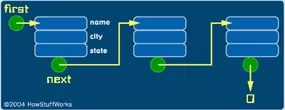
Structures can point to themselves. This allows you to chain identical records together. The result is a linked list. It is a standard way to organize data in C.
Here is how you define it:
typedef struct { char name[21]; char city[21]; char state[21]; Addr next; } Addr;
Addr first;
The next field holds the address of the subsequent record. You use a single pointer variable to start the chain.
The Cost of Flexibility
The compiler allows you to bend rules that might seem counterintuitive at first glance. With enough experience, you can engineer structures that look like the one shown above. It’s a power move.
But it’s not without risk. You’re walking a fine line between clever code and unmaintainable spaghetti.
Why It Matters
This isn’t just about syntax. It’s about what the language permits you to do when you push against its constraints.
- Control : You get granular control over memory layout.
- Interoperability : You can talk to C libraries more easily.
- Performance : Sometimes, bypassing safety checks saves cycles.
The catch? The compiler won’t save you from yourself. It will let you compile code that crashes at runtime.
How to Use It Safely
If you’re going to do this, do it with intent.
- Isolate it : Don’t spread this pattern throughout your codebase. Keep it in a small, well-tested module.
- Document everything : Future you will thank present you. Or hate you. Probably hate you.
- Use abstractions : Wrap the raw pointers or unsafe blocks in a clean interface. Hide the mess.
The Reality Check
Most developers don’t need this. They’ll use standard structures. They’ll be happier for it.
But when you hit a wall where the standard library doesn’t fit, you’ll be glad the compiler didn’t stop you.
The question is whether you’re ready to pay the maintenance cost.
It’s a trade-off. Speed for safety. Power for clarity.
You choose.