Long before we had fiber optics or 5G, humanity relied on something much simpler. We used flags. And wood. And light.
It sounds quaint now, like a hobby for reenactors. But for centuries, this was high-speed data transmission. It was the internet of the 18th and 19th centuries. The method is called semaphore.
How Claude Chappe Built the First Network
The real breakthrough happened in France. 1794. That is when Claude Chappe invented his system.
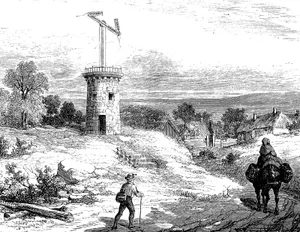
He didn’t just wave flags. That’s the movie version. Chappe built a mechanical network. Imagine towers spaced 5 to 10 miles apart. That’s 8 to 16 kilometers. Each tower had arms pivoting on a post.
The arms moved. They locked into positions. Each position represented a character or a code.
Observers at the next tower used telescopic sights to read the message. They saw the arm’s angle. They passed it down the line. It wasn’t instant. It wasn’t wireless. But it was fast for its time.
“Messages were read by telescopic sightings.”
This was visual signaling at scale. It connected distant points without a single wire.
From Towers to Train Tracks
Semaphores didn’t disappear when electricity arrived. They evolved.
Railroads adopted the tech. They needed signals that workers could see from a locomotive cab miles away. So, the mechanical arms stayed, but the context changed. Now, movable arms and rows of lights simulated those same angles.
A red light meant stop. A green light meant go. But the principle was identical. Visual input. Binary interpretation. Action.
It wasn’t about letters anymore. It was about safety. And flow.
The Human Interface: Flags in Each Hand
Then there was the maritime version. The one most people recognize.
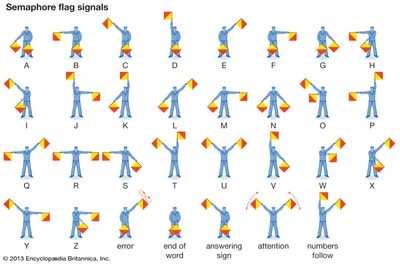
Sailors standing on deck. Arms extended. Small flags in each hand.
They moved their arms to different angles. This indicated letters of the alphabet. Or numbers. It was a direct human-to-human interface. No machinery. Just muscle memory and geometry.
You’d see this in naval exercises. Or in films depicting age of sail. It required two people. It required clear visibility. It required training.
Why We Stopped Looking Up
Modern semaphores between ships are largely abandoned. Why?
Because radios exist. Because GPS exists. Because we don’t need to squint at a stranger’s arm to know they’re turning left.
The visual semaphore was fragile. Weather could kill it. Fog could kill it. Darkness could kill it. Radio waves cut through all of that.
But the logic remains.
Every time a traffic light changes. Every time a signal on a subway platform turns red. You are seeing the legacy of Chappe’s arms. The arms pivoted on a post. Now, circuits flip states.
The medium changed. The message didn’t.
We used to build towers to see further. Now we build servers to see deeper. Same urge. Different tools.