
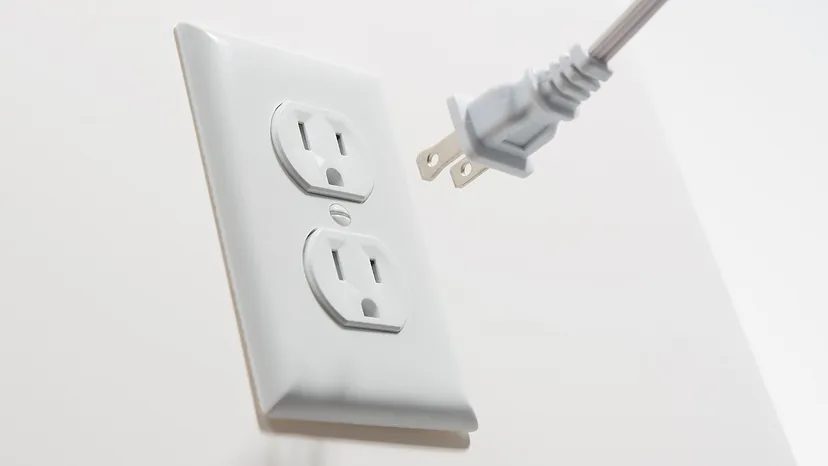
Look at the back of your hand. You probably don’t think about it. Now look at a standard 120-volt wall outlet in the US. There are two vertical slots and a round hole below them. The left vertical slot is slightly larger than the right. That left slot is the neutral. The right is the hot. The round one is the ground.
It sounds simple, but the logic underneath keeps your house from becoming a fire hazard and you from becoming a statistic.
How the circuit actually completes
Electricity doesn’t just exist in a plug. It flows. In a battery, current moves from one terminal to the other. In your wall, power moves from the hot slot to the neutral slot. When you plug in a toaster or a lamp, the appliance creates the bridge. Current enters through the hot prong, does work (heating coils, spinning a motor, lighting a filament), and returns via the neutral prong.
Without that return path, nothing happens.
Imagine replacing that light bulb with a thick, solid wire connecting the hot and neutral slots directly. There is no resistance. No limit. An insane amount of current tries to rush through that wire. The circuit breaker in your panel detects the surge instantly. It snaps. The power dies. The breaker didn’t fail; it worked exactly as designed. It stopped the wires inside your walls from melting and starting a fire.
Why you have two return paths
Here is the part that confuses people. The neutral and the ground are effectively the same at the breaker box. Both wires from every outlet in your house connect back to the same grounding point. So why keep both?
Because they do different jobs while traveling.
The neutral carries the current back to the source under normal conditions. The ground does nothing when everything is working correctly. It sits there, ready to act.
Most appliances with metal casings use a three-prong plug. This includes your computer, even if the case is plastic, if the internal power supply is metal. The metal shell of the appliance is wired directly to the ground prong.
Suppose a wire comes loose inside that metal case. If the loose wire touches the shell and it is a hot wire, the whole case becomes electrically live. Touch it, and you take the full voltage through your body.
But if the case is grounded, the electricity from that loose wire flows straight to ground. The current spikes. The breaker trips. The appliance stops working. You get a dead toaster and a mild annoyance. You do not get a heart attack.
The danger of the “cheater plug”
You can cut the third prong off. You can buy an adapter that lets you plug a three-prong device into a two-prong outlet. The device will turn on. The light will shine. The heater will heat.
You have just removed the safety net.
If that internal wire fails, there is no path to ground. The current has nowhere to go but through you. Using a ground adapter is not a minor inconvenience; it is a direct removal of protection against electric shock. It puts you, your home, and your equipment at risk.
Quick answers to common plug questions
Are two-prong outlets legal?
Yes. Existing two-prong receptacles are allowed under the National Electrical Code. You can even replace one with another two-prong outlet if no ground wire exists in the circuit.
Why do we use three-prong plugs?
To protect users of metal-encased appliances. The third prong connects the metal casing to ground, providing a safe path for stray electricity to flow and trip the breaker instead of passing through a person.
Can you cut the third prong off?
Physically, yes. Functionally, you are disabling a critical safety feature. The appliance works, but you are exposed to shock if an internal fault occurs.
Are plug adapters safe?
No. Ground adapters remove the safety function of the ground prong. They are not recommended for regular use.
Which wires connect to which pins?
– Neutral (left slot): White wire connects to the silver screw.
– Hot (right slot): Black wire connects to the brass screw.
– Ground (bottom slot): Green wire connects to the green screw.
The ground pin isn’t just extra plastic. It is the difference between a tripped breaker and a fatal shock. Keep it attached.