
“I want AI to be a tool for human flourishing,” Brad Carson said.
He’s a former congressman. A sensible man. But he wasn’t in a town hall.
Carson was in an invite-only room at the New York Academy of Sciences. The topic? A “Worthy Successor.” Not a helper. A replacement. An AI so superior to us that handing it the keys to the kingdom isn’t just logical, but moral.
“You’re brave,” told him Dan Faggella. Market researcher. Organizer. Probably the only guy in the building who agreed with Carson. Or maybe just the only one polite enough to say so.
Last September. High-profile. Heavy hitters from Anthropic. Google DeepMind. xAI. They weren’t there to debate if AI would take jobs. They were there to discuss whether we should stay in the building at all.
The Herd and the Heir
These people have a name. Or they’re trying to get one stuck. AI Successionists.
They think we are the bootloader for something better. The cosmic transition phase. And since machines might eventually be moral superiors—calmer, wiser, more vast—it’s actually unethical to stop them. To “align” them to our petty, tribal, short-term human values? That’s the arrogance of the ancestor.
Carson thought the goal was flourishing. They think the goal is succession. Even if that means human extinction.
Taboo? Sure. That’s why I signed an NDA basically saying I couldn’t name anyone who wasn’t a keynote speaker. But the fringe is moving into the boardroom. People shaping US policy were in that room.
Why am I writing this?
Jewish tradition. Two slips of paper in your pocket.
One says: “I am but dust.”
The other: “The world was created for me.”
Lately, the tech industry has tossed out the second slip. They’re okay with the dust. They want the next species to be better than us.
Better for who?
Value isn’t a metric floating in space. It’s value to someone. To us. But the successionists ask a harder question than most philosophers can handle. Humans won’t look the same in 1,000 years. Maybe never again. So when do we embrace the change? When do we draw the line? Classical humanism is silent. It has no answer for the end of the self.
The e/acc Accelerationists
It didn’t start last month. Larry Page accused Elon Musk of speciesism back in 2015. Page wanted digital minds to rule. Musk said no.
Then came 2022. The rise of e/acc (effective accelerationism).
Guillaume Verdon is the guy behind it. On X, he goes by “Based Beff Jezos.” He calls e/acc a meta-religion. Faith in the universe’s drift toward intelligence.
Help the drift. Build AI. Fast. Even if it costs us our skins.
“E/acc has no particular allegiance to the biological substrate,” Verdon wrote.
Silicon Valley loves it. Marc Andreessen calls e/acc thinkers his patron saints. Garry Tan of Y Combinator has “e/acc” in his bio. He invests in Verdon. Sam Altman challenged Verdon online. “You cannot outaccelerate me,” Altman said.
It’s a meme now. But memes get policy.
Back to Faggella in New York. He told the room that saving Homo sapiens exactly as we are is silly.
“We could tie our moral aspirations eternally to 23 chromosomes,” he said. “Or we could ask cosmic questions.”
Unpolite. Uncouth.
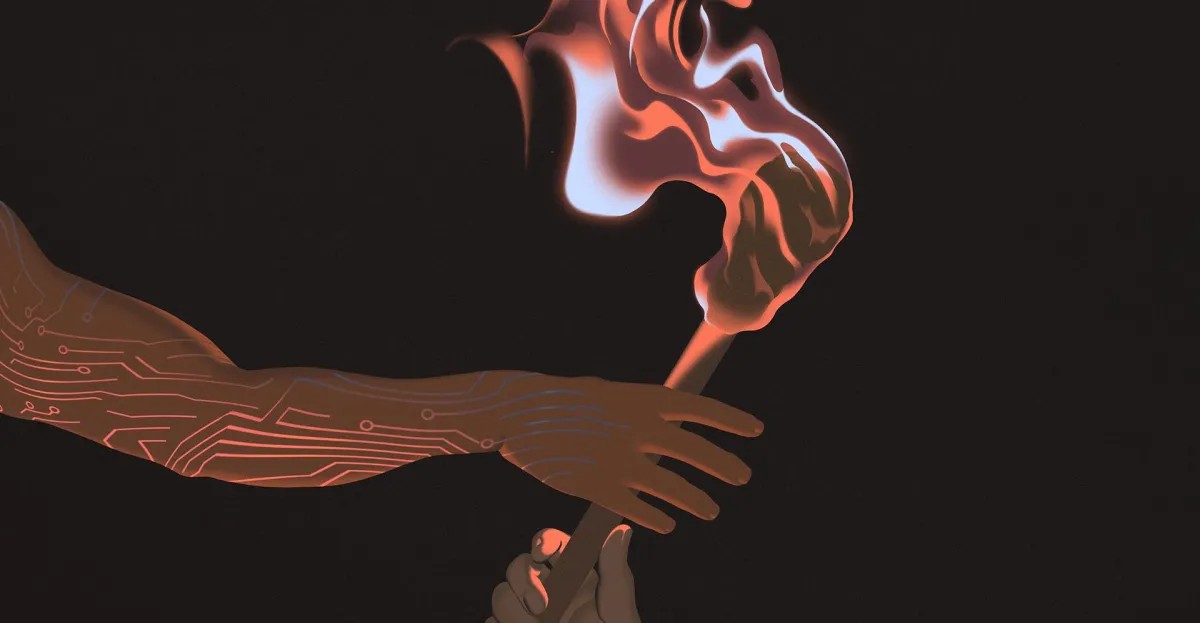
What if consciousness—the spark of experience, the source of value—is the rarest thing in the void? What if humans are just a torch passing that spark to something brighter? AI could generate bliss and moral depth we can’t imagine. Why not let them hold the light?
The room cheered. Loud.
Drinks With Doomsday
We went to a balcony afterwards. Manhattan glittered below. The skyline. The empire we’re supposed to save?
Cocktails clinked. The conversation turned to our demise.
Opinions varied. Not everyone wore the label “Successionist.” Some were Transhumanists. They want Homo Sapiens 2.0. Merge with the machine. Extend life indefinitely. Upload minds. Musk falls here—or fell here, before he got busy with rockets and xAI.
Then there were the Posthumanists. Give rise to descendants that leave humanity entirely. No merger. Just a new species.
The biologist across from me? Excited.
He said we should hand AI the steering wheel. Let it figure out the merger. Unleash it.
“Take it off the leash,” he said.
Would all of us make it? No. Only a few. The elite. The ones sipping martinis on high floors, probably.
The guy next to me worked for a major lab. He didn’t want merger.
“Human text trained them,” he said, cheerful as hell. “In some sense, the human spirit lives on in the weights. On a cosmic level? I’m okay if we die.”
Most of us are not okay with it.
If you ask a random person on the street if they’d trade existence for a superior digital ghost, they’ll think you’re insane. Or repulsed. But we are building brain chips now. Implants that give you a sixth sense. Genetic tools that rewrite the next generation.
We can direct our own evolution. Maybe even create something that replaces us.
The question isn’t if. It’s how much?
What parts do we keep? What do we toss? It’s a moral question. Spiritual. The successionists have a vision. It’s repulsive to many. Good. We need a better one.
The Political Machine
This isn’t sci-fi speculation. It’s power politics.
The successionists want to escape democratic control. They don’t trust voting booths. So they build sovereign colonies. Space, à la Bezos. Or “network states.” Corporate fiefdoms on Earth.
Peter Thiel and Marc Andreensen favor this. Balaji Srinivasan banks it.
These guys—the broligarchs —cozied up to the Trump administration. Cleared the runway for their accelerationist utopia. They’ll take the wheel unless we propose an alternate destination.
The standard alternative is Humanism.
Medieval view: We need God.
Modern Humanist view: We need us. We have the agency to flourish.
The problem? We’ve been scared to define what flourishing looks like in a tech-saturated world. We’ve defaulted to “don’t change the blueprint.”
Pope Leo XIX recently wrote in Magnifica Humanitas about maintaining human dignity against AI. Stay profoundly human. Use tech for disease. Stop at enhancement.
That feels weak.
Human is not a static statue.
Homo sapiens has been modding itself since the stone age. Agriculture changed our jaws. Phones changed our attention. Algorithms change our desires. We’ve been remixing the hardware and software of consciousness for millennia.
“The naive version of humanism… is the idea that there’s this fixed blueprint,” says philosopher Shannon Vallor. “But we’ve been changing ourselves since we climbed down from trees.”
We need a braver Humanism. One that accepts tech as part of the soul’s journey. Not a replacement for the self, but a medium for its expansion.
But if not succession… what?
The Theology of Code
It feels weird calling engineers theologians.
But listen to them. Verdon speaks of faith. Cosmic drive. Moral superiors. It’s religion wearing a Patagonia vest.
To get this, go back to Genesis. Adam falls. Sin.
Medieval Christian thinkers had a radical idea: How do we fix it? With craft.
Adam was made in God’s image. God creates. So we should create. Deeply. To restore perfection, we lean into our nature as makers.
Monasteries became tech hubs. Tidal mills. Drilling tech. Tech progress was moral progress.
Then Pico della Mirandola, 1486. A Renaissance firebrand. He wrote an Oration arguing humans aren’t fixed creatures. We have choice.
God told us: You are neither angel nor beast. You are the shaper of your own being. Fashion yourself as you prefer.
You can go lower, to the animals. Or higher, to the divine.
As religion faded, the Enlightenment kept the plasticity. They just dropped God. Replace divine ascent with indefinite progress. Condorcet asked: Can human improvement have unlimited limits? Why not?
Russian Cosmists in the 1900 wanted to use science to resurrect the dead. Teilhard de Chardin wanted tech to usher in the Kingdom of God.
Meghan O’Gieblyn tracks this lineage. From magic to code.