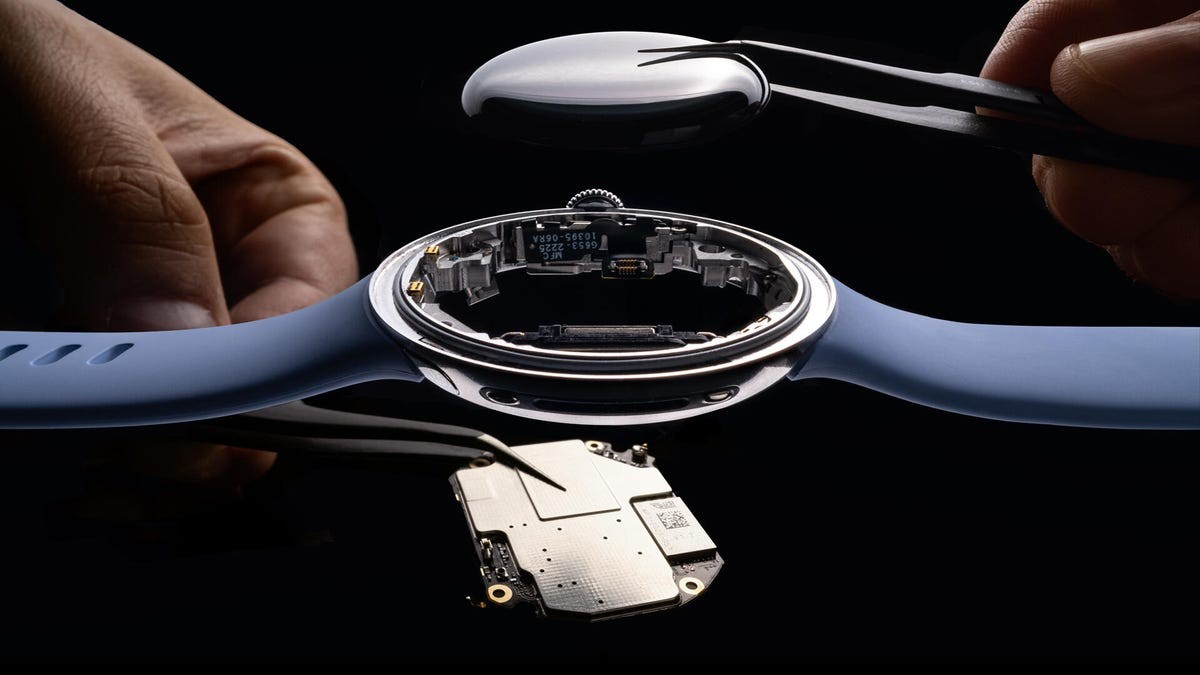
Know what a spudger looks like?
I didn’t.
Not until I had one pressed against my fingertips while performing open-heart surgery on a Google Pixel Watch 4. It’s a plastic stick. One end pointy. One flat. The instructions called it a tool. My hand called it a lifeline.
I was attempting a full screen replacement at home, guided by iFixit’s text. Spudging turns out to be art. Press. Pry. Coax. Don’t scratch the metal. Then the instructions shifted gears. Down with the spudger. Up with the tweezers. Scorpion-tail sharp.
I wielded them badly.
Trying to peel a sticker off a screen connector. A sticker glued there to keep the watch alive. The manual said: be careful. If you tear this, you die. I began to sweat. Frustration mounted. Have you ever tried removing chewing gum from wet hair? Try that with circuitry involved. And no, peanut butter isn’t an option for smartwatches.
Am I a technician? Hardly. An ambitious amateur at best.
I helped my dad fix a TV with a soldering iron when I was ten. That was it. Maybe a few supervised tinkers at tech conferences. I’m decent at jigsaw puzzles, sure. That’s the resume. But I did this repair because I believe product longevity matters. Less waste. Less mining for rare earth metals. Fewer child labor camps in conflict zones. More bang for your buck.
Repairing isn’t just convenience. It’s ethics with a screwdriver.
Right-to-repair laws are finally taking hold. Every US state has introduced legislation. Ten are active. The EU is jumping on board in July. Companies should be making easier devices. Theories aside, the reality is glacial progress.
Kyle Wiens, CEO of iFixut, calls the current landscape “uneven.” Legally, we have won. Practically? Not yet.
The Wearable Problem
I picked the Pixel Watch 4 to test my limits. It’s the only smartwatch maker truly swinging for the fences here. Google rebuilt the device from scratch. No glue.
Think about that. No glue.
Traditional watchmakers are artisans. Precision. Dexterity. Steady hands. I lack those qualities. I don’t even possess them innately, let alone cultivated. I could have chosen a laptop. Or a phone. There are cafes, repair shops, Apple Genius Bars ready for those tasks. Wearables don’t have that safety net yet.
Why does it matter? Because we are covering our bodies in them. Sleep trackers. Workout counters. AI rings. Glasses. Earbuds. These aren’t cheap toys. They should outlast our phones. If they break and stay broken, they become trash. E-waste is already choking the planet.
Cornell and University of Chicago researchers put it bluntly in a recent Nature study. Health wearables demand could hit 2 billion units by 2100. That means 100 million tons e-waste. Pollution everywhere.
The carbon footprint lives in the circuit board production. Make the boards modular. Reuse them. The mining slows down. It’s math. It’s logic.
So why don’t more companies do it? Perception.
They say it’s impossible. They hide behind waterproofing arguments. They push trade-in programs instead. Matt White, from Cambridge Consultants, calls wearables “the most challenging frontier of consumer tech.” He’s not theorizing. He’s built one.
Met White in Vegas last year. Dim hotel room. Not the usual CES shiny launch. They showed off Ouroboros. A concept repairable smartwatch. The goal was finding the roadblocks. Engineering. Culture. Law.
It requires a leap of faith. And guts.
White says you can’t just patch repairability in later. It has to be the north star. A business transformation, not just a design tweak.
Inside the Pixel 4
Google thinks it struck gold with the Watch 4. Francis Hoe, the product manager, admits reception exceeded hopes.
iFixit gave it a 9/10. Most smartwatches get a 3. Even 4 if they’re lucky.
Reddit users cheered. One guy swapped the screen in under an hour. He said it was easy. Small hands might have helped. I took ninety minutes. I nearly broke things.
The iFixit guide called the job “moderate.” Estimated time: thirty to sixty minutes.
I missed that mark by a half hour.
The exterior of the Pixel Watch 4 looks just like its predecessor. Look closer. Almost nothing is the same. Even the screws changed. Hidden under the band straps. Previously? Just glue sealing the fate of the device.
Now parts come out. Parts go back in.
Google re-engineered the assembly order. Shrank components. Swapped the haptic engine. Built rugged connectors meant for abuse. The battery was the nightmare scenario. Smaller battery usually means shorter life. For a fitness tracker, battery is king. Google couldn’t accept a penalty for repairability.
Some argue waterproofing makes modularity impossible. IP68 ratings require seals. Glue creates perfect seals. Screws and O-rings are risky.
Ben Hatton, an analyst, says this excuse is fading. You can have IP68. You can have screws. It’s not a sacrifice. It’s just different engineering.
Waterproofing was non-negotiable for Google. I tested it myself during assembly. Those O-rings? Tiny rubber donuts. Getting them back on 2mm screws felt like playing a game of Hoopla with ants. Essential if I want to shower with my watch. Still. I did it.
Companies give up when things get hard.
Repairs fall to the firing line first when deadlines loom.
White sees this happen constantly. Engineering teams pressure to launch next month. Repair features get cut. They’re the first to die. Google fought this. They chose the user over the easiest path. People are keeping devices longer. They didn’t want to lose that momentum.
Fairphone’s Earbuds
If anyone challenges the status quo in consumer tech, it’s Fairphone. Dutch company. Repairable phones. An annoyance to giants like Apple and Samsung, if anything.
They entered the audio game around 2021. Released the Fairbuds. Over-ear models too.
Headphones are disposable to most people. They’re cheap peripherals. Things you use until they snap, then toss. You probably threw out a pair recently. Did you try to fix them?
No? You’re normal.
The industry told you they were impossible to fix. That’s the narrative they sold us for years.