
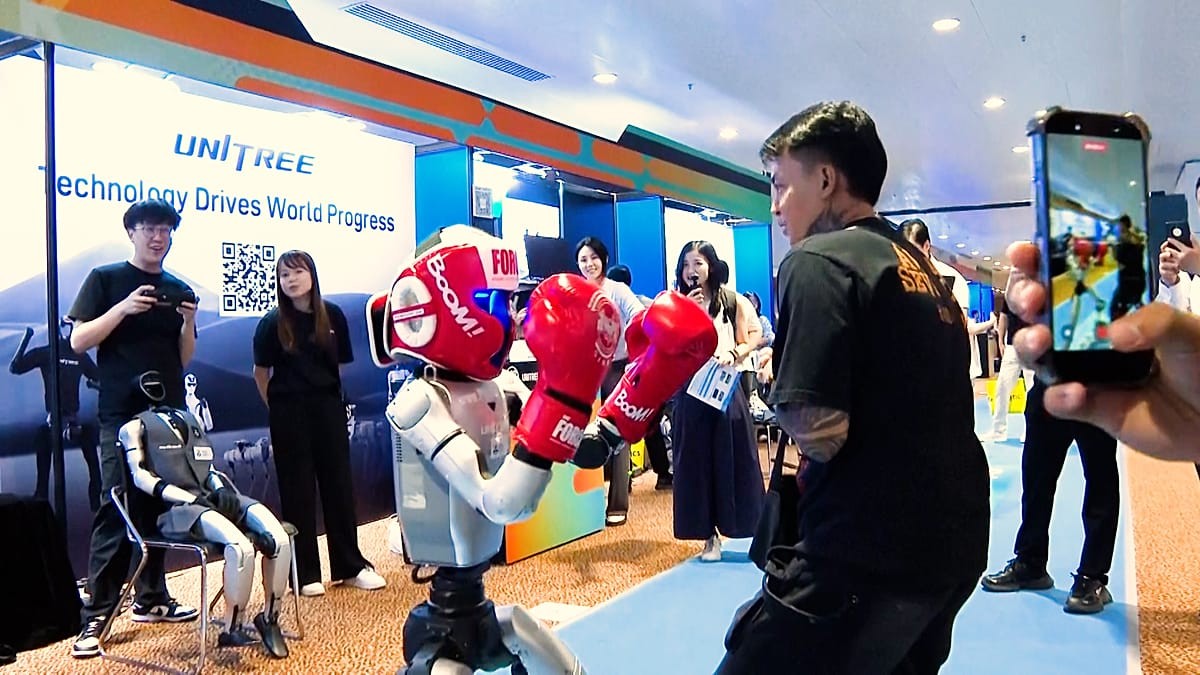
At the recent InnoEx technology fair in Hong Kong, the future of automation was on full display. More than 100 humanoid robots were showcased, demonstrating a rapid shift from experimental prototypes to machines capable of complex physical tasks and sophisticated social interaction.
The exhibition, part of Hong Kong’s Business of Innovation and Technology Week, featured heavyweights from the sector, including AgiBot, EngineAI, UBTech, and Unitree —four of the five top-selling humanoid robot manufacturers globally for 2025.
From Physical Prowess to Human-Like Interaction
The robots on display highlighted two distinct evolutionary paths in robotics: physical dexterity and social intelligence.
- Physical Agility: Hangzhou-based Unitree captured attention with its G1 robot, which performed boxing demonstrations with visitors. Meanwhile, EngineAI showcased the PM01, a model capable of flipping, rolling, and dancing, signaling a move toward robots that can navigate and interact with dynamic environments.
- Social and Emotional Intelligence: Other exhibitors focused on the “human” element. DX Intech Technology presented robots equipped with soft, synthetic skin to encourage tactile interaction. Novautek presented a more traditional design with screen-based faces, aiming to develop robots with distinct personalities capable of providing emotional support and specialized teaching.
These advancements are driven by Large Language Models (LLMs). As one robot noted during a demonstration, its ability to answer complex questions stems from an internal “omniscient brain” that continuously evolves through ongoing learning.
The Business Case: Efficiency and Unbiased Interaction
The push for humanoid robots is not merely about novelty; it is about finding practical, scalable uses in the service economy. Some manufacturers report that their robots are already deployed in Chinese museums and government buildings to act as guides.
A provocative argument emerged from EngineAI regarding the social utility of robots. The company suggests that as AI matures, humans may actually prefer interacting with machines over people in commercial settings.
“A salesperson is biased… [they] will convince me to make a decision for [their] advantage,” noted Robert Chan of EngineAI’s global strategy office.
By removing human bias and the pressure of sales tactics, robots could provide a more neutral, information-driven consumer experience.
The Geopolitical Context: A New Technological Frontier
The sheer scale of China’s robotics industry is staggering. As of 2025, the country boasts over 140 manufacturers and more than 330 different humanoid models. This rapid expansion is fueled by several strategic advantages:
- Low-Cost Engineering: China’s manufacturing ecosystem allows for rapid prototyping and scaling.
- Collaborative Ecosystems: Unlike the more siloed approach seen in the US and Europe, Chinese firms often benefit from a culture of rapid knowledge exchange.
- State Support: Humanoid robotics is a central pillar of Beijing’s latest five-year plan, which prioritizes “frontier science and technology.”
This surge in development places robotics at the heart of a broader technological rivalry between China and the United States. As these machines become more capable, they move beyond simple automation and into the realm of national security and economic sovereignty.
Conclusion
China is rapidly transitioning from a manufacturer of components to a global leader in integrated humanoid robotics. By combining mass-production capabilities with advanced AI, the country is positioning itself to redefine both the labor market and human-machine social dynamics.