
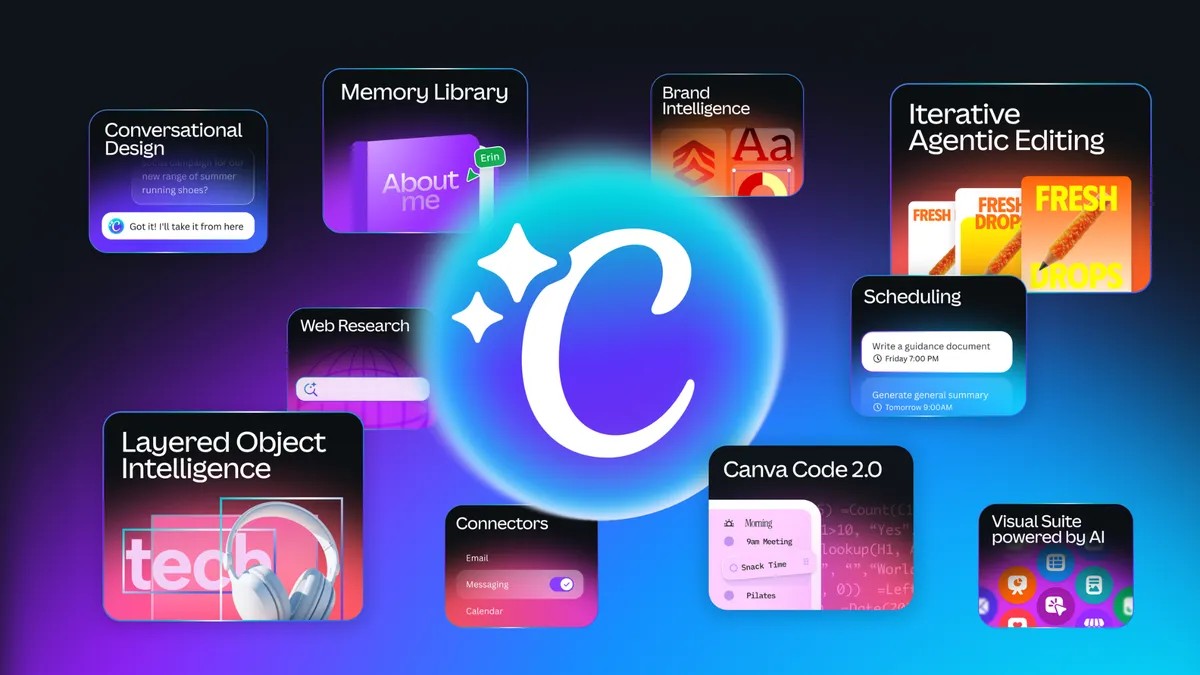
Canva is undergoing a fundamental transformation. At its annual “Canva Create” conference, the design giant unveiled Canva AI 2.0, signaling a massive shift in its core identity. No longer just a place to make posters or social media posts, Canva is repositioning itself as an AI-driven platform that integrates deeply into the modern digital workspace.
A Fundamental Shift in Identity
For years, Canva has been recognized as a user-friendly alternative to professional suites like Adobe Creative Cloud. While it has long utilized artificial intelligence to assist with design tasks, the company is now reversing its fundamental architecture.
According to Robert Kawalsky, Canva’s global head of product, the company has effectively “flipped the platform on its head.”
- The Old Model: A design platform supplemented by AI tools.
- The New Model: An AI platform that utilizes design capabilities as one of its many features.
This evolution is backed by years of strategic investment, including the development of proprietary models and the acquisition of specialized AI firms like Leonardo. By making this move, Canva is attempting to move from being a “destination” for specific tasks to becoming an “operating system” for daily productivity.
Integrating into the Workflow: The Rise of “Connectors”
One of the most significant aspects of the 2.0 launch is the introduction of “connectors.” Canva is breaking out of its own interface and moving into the tools where professionals already spend their time. Through third-party integrations, users can now access Canva’s AI directly within:
- Communication tools (Slack, Zoom)
- Productivity suites (Google apps, Notion)
This strategy aims to make Canva’s AI as ubiquitous as ChatGPT or Microsoft Copilot. Instead of opening a new tab to design a graphic, users can interact with the AI within their existing workflow to perform a variety of non-design tasks.
Beyond Graphics: Agentic AI and Business Productivity
The new update expands Canva’s utility far beyond visual aesthetics. The company is leaning into “agentic AI” —tools that don’t just respond to prompts but can perform autonomous, scheduled tasks. New capabilities include:
- Meeting Management: Preparing for and summarizing meetings.
- Administrative Assistance: Searching the web for insights, creating files, and managing spreadsheets.
- Workflow Automation: Scheduling reminders for the start and end of the workday or managing email drafts.
This expansion suggests that Canva is targeting the broader “knowledge worker” market, competing not just with Adobe, but with productivity giants like Microsoft and Google.
Why This Matters
Canva’s pivot highlights a broader trend in the tech industry: the race for the “AI Agent.” As generative AI matures, the value is shifting from simple chatbots to integrated agents that can execute complex workflows across multiple applications.
By lowering the barrier to entry for professional-grade content and integrating directly into business communication tools, Canva is attempting to bridge the gap between creative expression and corporate utility.
The rollout of these features is currently in a research preview, with wider access expected to follow in the coming weeks.
Conclusion
Canva is evolving from a specialized design tool into a comprehensive AI-driven productivity ecosystem. By integrating into existing professional workflows, the company is positioning itself to be an essential, automated partner in the daily lives of workers worldwide.