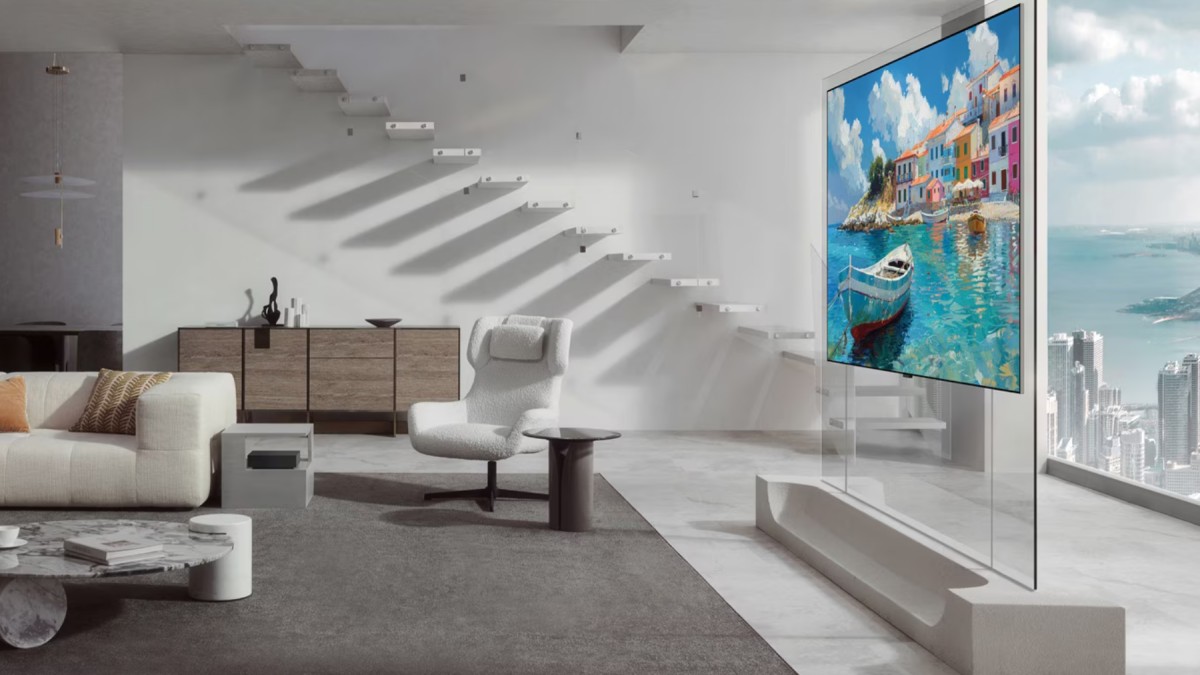
The luxury television market has a new heavyweight contender. LG has officially opened preorders for its resurrected W6 Wallpaper TV, but the announcement has brought a polarizing question to the forefront: Why does this “art TV” cost so much more than its competitors?
With a starting price of $5,499.99 for the smallest model (77 inches), the W6 is positioned far above the standard consumer bracket. To understand whether this price tag is justified, we must look beyond the marketing and examine the fundamental differences in technology, design, and target audience.
The Technology Gap: OLED vs. Neo QLED
At first glance, consumers often compare the LG W6 to Samsung’s The Frame Pro, which retails for $3,999.99 for an 83-inch model. However, comparing these two is an “apples to oranges” scenario because they utilize entirely different display technologies.
- LG W6 (OLED): Uses self-emissive pixels, meaning each pixel produces its own light. This allows for perfect blacks and infinite contrast. LG has pushed this further with “Brightness Booster Ultra” and “Hyper Radiant Color Technology,” claiming the W6 is nearly four times brighter than standard OLEDs and significantly more reflection-free.
- Samsung The Frame Pro (Neo QLED): Uses Mini-LED technology. While Samsung’s high-end models use “full array local dimming” (bulbs behind the entire screen), the Frame Pro uses a more simplified system with LEDs arranged along the bottom pointing upward. This makes it a capable “lifestyle” TV, but technically inferior to a high-end OLED in terms of precision and depth.
Engineering a “Wallpaper” Experience
The premium price of the LG W6 isn’t just for the picture quality—it is for the form factor.
LG has managed to pack its advanced OLED technology into a chassis just 9 millimeters thick. To put that in perspective, the W6 is thinner than a closed MacBook Pro. This extreme thinness is what allows the TV to truly mimic a piece of art or wallpaper, sitting flush against a surface rather than protruding like a traditional electronic device.
For enthusiasts, the specs also lean heavily toward high performance:
– Refresh Rate: The W6 supports up to 165Hz, outperforming the Frame Pro’s 144Hz, making it a viable option for high-end gaming.
– Visual Clarity: LG’s focus on reflection management addresses the traditional Achilles’ heel of OLED technology, making it viable for bright, sunlit living rooms.
The “Lifestyle TV” Paradox
The high cost of the W6 raises an interesting question about the “Lifestyle TV” category. Samsung has a way of competing with LG, but not necessarily through The Frame.
The Samsung S95H OLED, for example, offers many of the features people want in an art TV—a matte, glare-free screen, a sleek metal bezel, and access to an art store—but it does so within a high-end OLED framework. This suggests that the “Art TV” premium is actually a combination of two different costs: the cost of top-tier OLED technology and the cost of specialized industrial design.
Is the Price Justified?
It is important to note that $5,500 is not an arbitrary number. High-end OLED technology is inherently expensive to manufacture. For comparison:
– A 77-inch LG G6 OLED costs approximately $4,499.99.
– A 77-inch Samsung S95H OLED costs approximately $4,499.99.
The W6 carries a premium because it is not just a high-end TV; it is a specialized piece of ultra-thin hardware designed to disappear into home decor.
Conclusion: The LG W6 Wallpaper is not a mass-market product, but a luxury convergence of cutting-edge OLED performance and extreme industrial design. While the price is steep, it reflects the high cost of engineering a screen that is both visually superior and physically unobtrusive.