
Ethernet didn’t just win. It is dominant. But before it became the global standard for home routers and office switches, there was IBM’s Token Ring. This is not just an option. This is the opposite of how data travels over a network.
Ethernet is confusing. It is based on random intervals between transmissions. It waits. listens for collisions. guesses. Token ring is different. It was strict. Orderly. Predictable.
Instead of a busy crossing, think of it as more of a relay race where only one runner is in hand at a time.
How Token Ring controls access
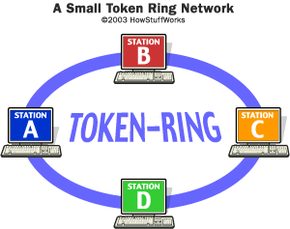
The Ethernet node waits for silence and the Token Ring node waits for authorization. Networks organize nodes into logical rings. The frame moves in one direction around that loop. Once the frame has completed its cycle, the sender discards it.
The whole system is based on tokens.
This special frame gives the station the right to transmit. Without it, you sit and wait. It gets you going.
- Initialization : The network starts generating the token. circles the ring as you would any other frame.
- Capture : A station that needs to send data catches the token. It doesn’t just wait for it to pass. Replace the token frame with your own data transfer frame.
- Send : This information frame surrounds the entire network. Other nodes recognize it. They don’t stop it. They just let it pass.
- Release : When the frame returns to the sending station, the station discards the frame. Then create a new token and pass it to the next node.
This mechanism eliminates the guesswork. Nodes do not search for carrier signals. They don’t listen for collisions. Tokens offer an absolute guarantee. You can transfer without interruption.
Communication is deterministic because each station sends only one data frame before handing over control. fair enough. Each node has a turn. No one starves. Nobody holds the line.
Speed and hardware limitations
Token Ring isn’t slow, but it isn’t lightning fast either. These networks usually operate at 4 Mbps or 16 Mbps.
That was enough for a while. Handles business traffic very well. It is very stable. However, stability does not always mean scalability.
FDDI exception
The token passing family includes the faster Fiber Distributed Data Interface (FDDI).
FDDI uses fiber optic rings. More specifically, a couple. Each ring passes tokens in opposite directions. This redundancy means that if one fiber goes down, the other fiber can continue to use the network.
FDDI provides 100 Mbps. In the late 1990s, that was a lot of money. Commonly used in fast backbone networks.
But then Ethernet was developed.
Fast Ethernet is here. The speed was also 100 Mbps. It’s cheaper. Easier to manage. You didn’t need specialized fiber knowledge or complex ring management tools. You just plugged into a switch.
FDDI is not dead because it is bad technology. Obsolete because it was expensive and complicated. Ethernet is enough. It’s everywhere.
Why it matters now
Token Ring or FDDI is rarely seen in modern environments