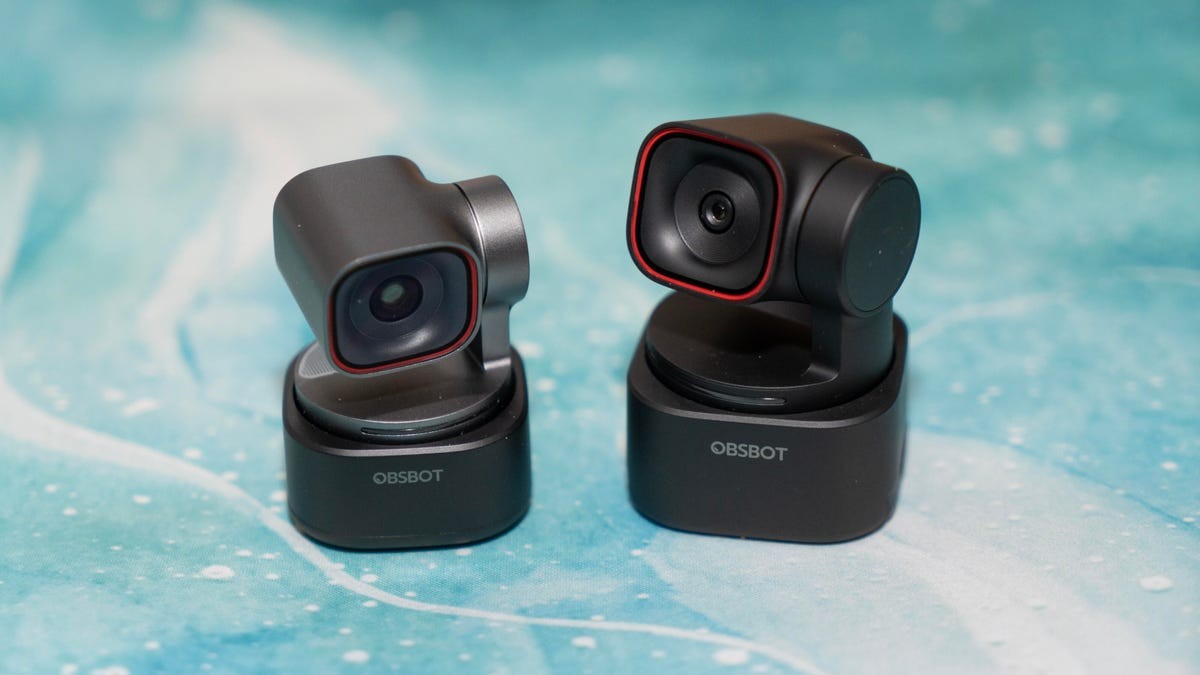
Obsbot’s latest Tiny 3 series of robotic webcams sets a new standard for quality and versatility. Catering to streamers, podcasters, musicians, and everyday users, these devices deliver exceptional audio and video performance. The high-end Tiny 3 stands out as the most advanced webcam tested, while the more affordable Tiny 3 Lite offers nearly the same features for significantly less—making it an exceptional value.
Audio Reinvented
The most notable improvement over the Tiny 2 is the dramatically enhanced audio quality. Both models feature a MEMS solid-state mic array with omnidirectional and directional pickups, ensuring consistent, clear sound with minimal distortion. Obsbot Center software provides five modes, including “Pure Audio Mode” for unprocessed recordings and “Spatial Audio Mode” for natural-sounding speech with noise cancellation. The directional modes are optimized for voice clarity, while the less successful “Smart Omni Mode” suffers from muffled output.
Tiny Size, Massive Performance
The Tiny 3 itself is remarkably compact—measuring just 1.5×1.5×1.9 inches and weighing 2.2 ounces—making it the smallest robotic webcam available. Despite its size, it boasts a high-quality sensor and multiple microphone pickups. This engineering feat comes at a premium: $349. The Tiny 3 Lite is slightly larger but still offers excellent performance at a more accessible $199.
Video Quality That Impresses
Both webcams deliver superb video quality, featuring excellent automatic white balance, autoexposure, and low noise in various lighting conditions. The Tiny 3’s superior HDR handling provides more even exposure across the frame, though the effect is subtle. Both models support unique 120fps 1080p streaming for smooth motion capture, though 4K at 60fps may offer better perceived sharpness for moderate movement.
Tracking and Automation
Obsbot’s robotic PTZ (pan-tilt-zoom) technology sets these webcams apart. Autofocus is fast and accurate, though frequent adjustments can be distracting. Tracking and autoframing keep subjects centered, and the new object tracking feature works exceptionally well for tutorials or demonstrations. Voice tracking enhances responsiveness, while hand tracking continues to struggle with left/right orientation.
Software Features and Limitations
The Obsbot Center software includes virtual camera tools like background replacement and a basic teleprompter. While background removal performs well, the new Avatar and Virtual Voice features are underdeveloped, requiring an account and functioning only on Windows. The eye contact feature, powered by Nvidia’s Maxine, requires a GeForce RTX 3050 or better and can produce unnatural results.
The Bottom Line
The Obsbot Tiny 3 series delivers class-leading performance in a compact package. The high-end model justifies its $349 price for those who need the latest features, while the $199 Lite version provides exceptional value. These webcams are a significant upgrade for anyone looking to improve their streaming, podcasting, or video conferencing setup.