


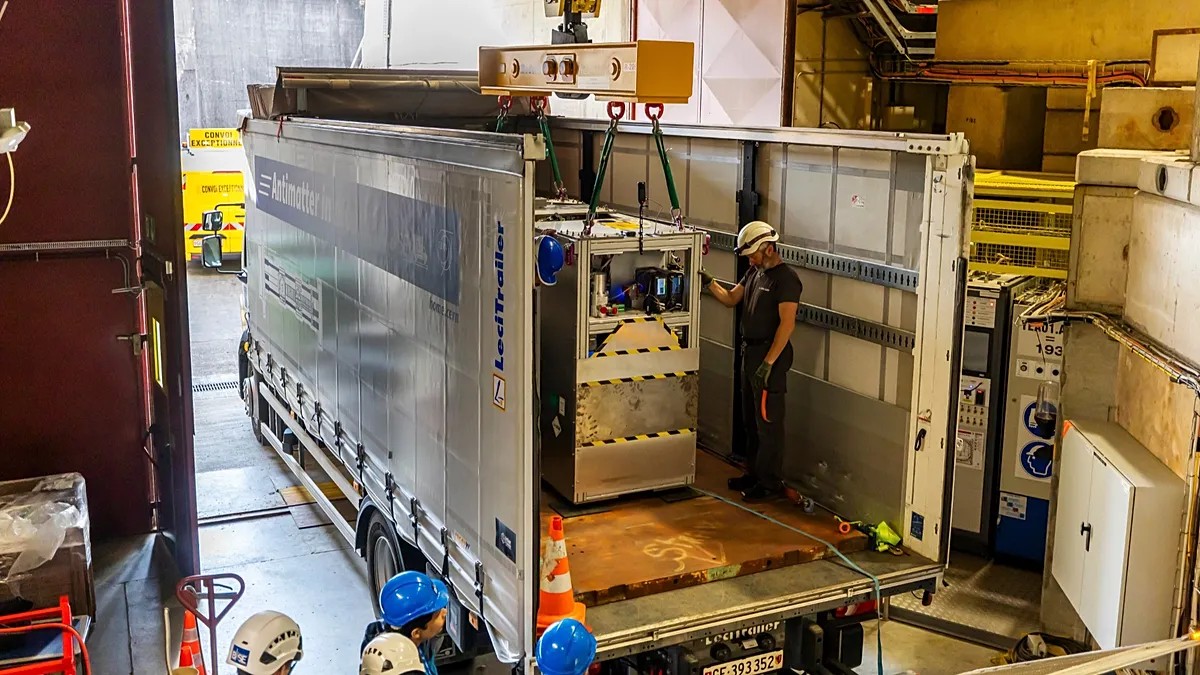
For the first time ever, antimatter – one of the universe’s most elusive substances – has been transported outside a laboratory setting. In a groundbreaking experiment, researchers at CERN successfully moved a sample of antiprotons in a specially designed container via truck, proving that these fragile particles can be safely relocated for further study.
The Challenge of Containing Antimatter
Antimatter is the opposite of ordinary matter; when the two collide, they annihilate each other in a burst of energy. This extreme instability is why antimatter research has been confined to highly controlled lab environments… until now. The antiprotons were encased in a one-meter cube called a “transportable antiproton trap.” This device uses supercooled magnets (down to -269°C) and a high vacuum to suspend the particles, preventing any contact with the container walls. The four-hour experiment verified that the antimatter could remain contained during real-world transit.
Why Transport Antimatter? The Universe’s Biggest Mystery
The ability to move antimatter opens up new possibilities for research. One of the biggest unsolved questions in physics is why the universe is dominated by matter rather than antimatter. According to Professor Tara Shears of the University of Liverpool, “Antimatter holds the keys to our understanding of why the universe is like it is… when the universe started, half of it was made of antimatter.” By transporting antiprotons to specialized labs with less interference, scientists can conduct more precise measurements and potentially unlock these fundamental secrets.
The Future of Antimatter Research
The experiment paves the way for transporting antiprotons to facilities like Heinrich Heine University in Düsseldorf, which offers a cleaner experimental environment than CERN due to reduced magnetic interference. However, significant hurdles remain. The current trap has only four hours of autonomy, while the drive to Düsseldorf takes eight.
“The moment these antimatter protons come into contact with normal matter, they annihilate each other… the key is stopping that from happening,” explains Professor Alan Barr of the University of Oxford.
Beyond the immediate scientific goals, the technologies developed for antimatter containment are likely to have broader applications. As Barr points out, pushing boundaries often leads to unexpected innovations: “You’re forced to invent technologies that end up being used elsewhere.”
The successful transport of antimatter marks a turning point in particle physics, promising deeper insights into the origins and nature of the universe. The journey from lab to road is just the beginning of a long road to scientific discovery, with unforeseen benefits likely unfolding in the future.


